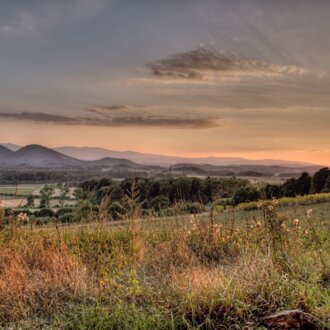

Rising to 1603 meters above sea level, Śnieżka is the highest peak of the Karkonosze Mountains and the entire Sudetes. That is why it is sometimes called the Queen of the Sudetes. It is a harsh peak, without vegetation cover, built of granite, whose slopes are covered with rocky debris. However, one cannot deny its beauty and majesty, which is why it is the most popular destination for mountain hikes in the Karkonosze. The border between Poland and the Czech Republic runs through the summit.
The Karkonosze are among the most beautiful and most frequently visited mountains in Poland. There are plenty of fantastic hiking trails here, and above all, picturesque hills and viewpoints – the vast majority of them are accessible even for beginner hikers, including families with children. You definitely must conquer Śnieżka!
High mountain climate and legendary winds
The high altitude determines the alpine climate prevailing on Śnieżka and the unfriendly conditions for plant vegetation – it is always colder here than on lower peaks. When going to Śnieżka, it is worth dressing warmly – during the summer season, maximum temperatures reach just a few or a dozen or so degrees Celsius. The average annual temperature is 0°C. Moreover, the winds blowing on Śnieżka are legendary – gusts of up to 300 kilometers per hour have been recorded!
You also need a lot of luck to admire the panorama of the Sudetes and surrounding areas from Śnieżka. For about 300 days a year, the summit is covered with a more or less dense fog. However, if you manage to reach the peak in good weather, Śnieżka rewards you with unforgettable views. It is enough to say that with good air clarity, it offers views up to even 200 km away!
Śnieżka visited already in the Middle Ages
The highest mountains, wherever they are, always attract people's attention and spark imagination. It was the same with Śnieżka, which people climbed as early as the late Middle Ages.
In the 17th century, a chapel was built on the summit, funded by the then owner of the surrounding lands. Traditionally, the day of the chapel's consecration became a holiday for mountain people and guides, and a mass is held annually on Śnieżka to commemorate this event.
The following years, including the 18th century, brought considerable tourism development and extraordinary popularity of Śnieżka – even on a European scale. This interest remains to this day.
Śnieżka stands out not only because of its height and the characteristic, practically vegetation-free summit. The landscape of this place is also shaped by human activity. A very popular and recognizable symbol of Śnieżka is the Meteorological Observatory. The characteristic “discs” attract hikers' attention from afar. They often also serve as a backdrop for souvenir photos or, as a symbol of Śnieżka and the Karkonosze, appear in tourist guides.
The building in this shape was put into use in the 1970s. However, the tradition of conducting meteorological observations on Śnieżka dates back to the end of the 19th century. Currently, the observatory is not open for visitors.
Recommended hiking routes to Śnieżka
There is no mountain hut on Śnieżka, and the local bar is not always available. However, you can easily use the services of a second catering point – right next to it, on the Czech side. Tourists looking for accommodation on the trail or a wider gastronomic offer should consider the mountain hut Dom Śląski located lower down.
How to get to Śnieżka? There are several routes to choose from with varying levels of difficulty and ascent times.
- About 3 hours are needed to reach the summit via the red trail, starting near the Orlinek hotel in Karpacz. The route passes by the Shelter over Łomniczanka and then to Dom Śląski. The trail is not accessible in winter.
- The second route from Karpacz is the black trail – the most difficult and steep, but it takes slightly less time, on average about 2.5 hours. It starts at the lower station of the cable car to Mała Kopa.
- The cable car is a good solution for those who cannot or do not want to walk the entire trail. The ride to Mała Kopa takes a few minutes, and from there it's much closer to the peak of Śnieżka. The easiest trail can be reached on foot in an hour.
- It is worth mentioning that easier conditions for reaching Śnieżka exist on the Czech side – this applies both to hiking and the cable car ride. You can also choose the yellow or green trail – both start from the Czech resort of Pec pod Sněžkou. The trails have similar routes, are not difficult, and offer many beautiful views. The easiest option, however, is to take the gondola lift – it comfortably takes you to the very top of Śnieżka in half an hour. There is one problem – the cable car does not operate on windy days.
Have questions?
See also